Friday, 21 March 2014

Fountain 37 The Market Square Castellane 11 August


The fountain in the market square

A boy kicks around a football. His shirtless father runs to return it. 
The tattoos on his chest rising and falling.

Behind the fountain, high on the cliff, is the Chapel of Our Lady of the Rock, 12th century.
Inside the chapel are the votive offerings that have been left as thanks.
136 engraved plates
21 bridal bouquets 
a given array after a vow to Our Lady, dating from 1757
a given array after the cholera epidemic in 1835
a table given by a released prisoner, dated 1875 
a table given after a smallpox epidemic, dated 1870,
a table given by a person who escaped a shipwreck in 1896

I first visited Castellane a couple years ago. 
I had thought I was "lost" in a fog high up in the middle of nowhere. 
Following the empty, single track lanes which were cut into the side of the cliff, 
it grew cold and started to rain. I had very little fuel or food. 
                          I had to guess which road to take as it was all too small for my map
 and the sun was buried under thick cloud. 

Expecting to be left for the vultures to pick at my bones, I suddenly came into Castellane. 
It was bubbling with people. The sun was raising steam off the pavement and the drenched campers. 
In the frenzy of my reprieve I bought something at nearly every bakery. Had I known about the Chapel of the Rock, I would have left votive offerings for Our Lady for her succour - mini-pizzas, olive and herb bread, flaked almond sticky buns, chocolate Chantilly cream cakes.

This year's visit it was blue skies and a white hot sun.
I parked up by one of the clusters of motorbikes. Streams of Harleys rumbled past, driven by smug, big chested men in sunglasses. It felt like a motorbikers' catwalk, and although Louise is far more beautiful than any of the mere machines that passed us, I felt inadequate. I can't do the "cool" look.
Five or six youngish Italian men, obviously enjoying strutting in their tight leathers, pointed at Louise and laughed. I presume at the enormous load that is strapped to her. When they saw me, modeling the latest "we are not amused" look, their struts melted into awkward tiptoes.


Saturday, 15 March 2014

Fountain 36 Fountain with a View Moustiers Sainte-Marie 11 August


                                                                    Looking south

 Moustiers was founded by Sainte Maxime, the bishop of Riez, who arrived from the Abbey de Lerins with a handful of monks in 434. (The Lerins Islands, situated off the coast from Cannes, had been inhabited by the Romans since the 1st century. They had attracted other island loving saints from afar, eg, St. Patrick who allegedly left Ireland to study there in the 5th century.) Initially the monks  lived in caves and drank from the spring which flows out of the cliff face. The town has been a site of pilgrimage since 470. (I have written a bit about this in the post "This is not how I was expecting it to be" 8th August.)
 

The present village was built on platform terraces a hundred metres up the side of a limestone cliff on the site of a 10th century castrum, or permanent village. A stream which runs through a narrow rocky canyon divides the town into two. The sound of water can be heard all over the village, as it flows down its natural course or is channeled into the numerous fountains, as a drone under the babble of the huge tourist population who come to wander the medieval streets and vaulted passages, and buy traditional faience pottery.


  heading east

    The Gorges of Verdun
  25 kilometers long and 700 meters deep


                                    The turquoise colour is due to its glacial sources. The fine minerals,
"rock flour" are suspended in the water and is called "glacier milk".


Sunday, 9 March 2014

Fountain 35 The Diane Fountain, Moustiers Sainte-Marie


I had driven for miles following the vague directions given by the stone mason's wife from the campsite at Malaucene. She had described the minutia of the campsite,  highlighting the dearth of children in a gleeful voice, but had failed to give the essential information, such as its name, which would enable me to actually find it. I stopped for directions at a table placed at the side of the road. A flimsy plastic awning sheltered a very round and flowery old woman who smiled and said that she knew of a lovely and economical campsite. Nevertheless, she appeared to not hear, or understand, when I asked for directions.

Then launching into a well rehearsed scenario, she offered me her wares in a clockwise order. I refused her offer of lavender sachets stitched into tiny purple and orange pillows, lavender and beeswax floor polish, lavender bath soap, lavender and honey throat pastilles, lavender infused olive oil. When she got as far as the jars of lavender honey, I knew that despite its cost, I must concede to a sale. Once our business was completed, she pointed to a rough tarmac road in the distance. 
"Suivre cette route. Ce n'est pas très loin."
I followed the ever narrowing road for twenty minutes or so. I had based my waning trust upon one faded sign with "Camping" painted in clumsy red letters. The road climbed and gave me a 180 degree view of the enormous slash of a turquoise lake nestled among nearly black mountains. I was about to give up and retrace my route when I saw a powow of white teepees on the horizon.


   Inside the church in the centre of Moustiers Sainte-Marie 
Mary modelling rather unusual colours from her normally sedate wardrobe


                                                               The Fountain of Diane

                 I have already written about this fountain in the August 11th posting, 
 so I will leave it at that.


          Everywhere the fragility of love.                


Monday, 3 March 2014

Fountain 34 Capitaine Vincens Herve' Barjols 10 August


Tucked somewhat incongruously at the end of a humble leafy square was this monument dedicated to the fallen soldiers of WW1. These are not fighting men engaged in battle. These are men at ease, their guns hang over their shoulders or rest on the ground. They chat, drink tea, conspire, console, joke and engage with their dog. They appear to be normal men, responding with their different emotions to their shared plight. The more time I spent looking, the more I wondered if they were waiting in the trenches for action or waiting in the after life for some sense to be made of it all. A couple of the men stare out at the viewer. And of course they would only be young, a similar age to my own son. Their hollowed eyes accentuated the distance between us. Their look saying, without judgement, "you can never understand how I feel, how we feel". And that is true, I and we will never understand.


                                                                            detail


                                          another fountain with metal bars to rest a bucket


                                        and another lavoir surmounted with a house plant


                                   and another lavoir with separate drinking water fountain


                                                 and another water trough style fountain

Thursday, 20 February 2014

Fountain 31 Place Malherbe, St. Maximin-la-Baume 10 August


Place Malherbe
 18th-century fountain topped with an obelisque

Although St. Maximin-la-Baume quite place, this roundabout was the hub around which local lads sported their whining two-stoke scooters or their parents' car. 
Behind me were a few shady terrace cafes, but I prefer a bench under a tree. 
Here I can relax and watch the world without the interruption of a waiter. 
A bench is a democratic place. 
I shared my lunch break with three Arab men eating ice cream, 
an older woman with hennaed hair and a panting pekinese 
whose lolling tongue was reminiscent of a proboscis. 

Earlier, at the cathedral, I asked a reluctant priest to bless the water I had collected. 
I had filled a vial with the rather scuzzy water from the holy water font by the west door.
Sometimes I feel a bit squeamish dipping my fingers into this unknown solution to bless myself. 
I try not to think of all the fingers which have preceded me over the centuries.
 And sometimes I do consider them and I feel a humble connection 
with the dirt and sweat and germs of all humanity.

Sunday, 16 February 2014

Fountain 30 The blessed Holy Water from Sainte Maximin-La-Sainte-Baume 10 August


According to The Golden Legend, Mary Magdelene, Mary Jacobus and Mary Salome, 
(the three Marys at the empty tomb of the risen Jesus) Lazarus and Martha (the brother and sister of Mary Magdelene), and a steward of their house, Maximinus,
were cast off from Holy Land by Roman persecutors in 42 a.d.
They were ushered into a fragile boat that had neither rudder nor sail, 
with the intention that they would drown,  however, they landed at what is now
Saintes-Maries-de-la-Mer, at the mouth of the Rhone, just west of Marseilles.


Upon arrival, Mary Magdelene converted all of Provence to Christianity then wandered in the mountains of Sainte Baume for thirty years and lived a solitary life of penance and prayer in a cave.
 On the day before her death she descended to find Maximinus 
in order to receive Communion and discuss her funeral arrangements. Legend also has it that she was born aloft to Aix in the arms of angels to receive viaticum, the Holy Eucharist, as part of the last rites.

There was (is) some dispute as to where her bones lie. *

According to Western, i.e  not the Eastern Orthodox tradition,
 from about 1050 Mary's relics were venerated at the Abbey of La Madaleine in Vezelay, Burgundy. Allegedly they had been moved from Sainte Maximin  in 771 to protect them from the invading Saracens. However in 1279, during an excavation ordered by Charles II, King of Naples, her shrine was discovered with an inscription explaining why the Magdalene's relics had been thus hidden.
Charles built a basilica on the site and in exchange for providing lodging for pilgrims,
 the town's people were exempt from paying taxes.
A contemporary, the Dominican Bernard Gui, chronicled miracles which further 
supported the argument that these were genuine relics. 
He wrote that a sweet spicy fragrance emanated from the sarcophagus' contents,
 and that a green shoot was found to be growing from  Mary Magdalene's tongue. 


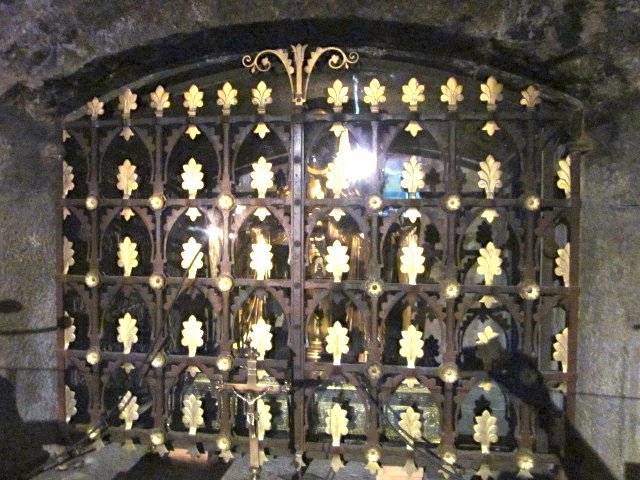
 Behind the gilt and bronze gates is the reliquary which contains a piece of Mary's
forehead where Jesus touched her after he rose from the dead and said the Aramaic equivalent of "Noli me tangere" 
(touch me not).


Noli Me Tangere by Alanso Cano mid 17th C


Adjacent to her reliquary is a 3rd Century marble sarcophagus 
carved in low relief with various scenes, including what is considered to be the oldest known depiction of the Nativity. It contains all the ingredients of a Christmas card: 
wise men bearing gifts, a manger with a swaddled baby overlooked by a cow and donkey,
a star over the stable and a bemused young woman sitting with her legs crossed.


Carved into the soft plaster, a large area of wall was "tagged" by hundreds of years' worth of visitors.
I'm not yet certain what the horseshoe shaped forms represent. If they are indeed horseshoes
 they could be there to bring more good luck to those at sea for they were often
 used on boats as well as on land. They could also be something akin to the Masonic Arch. 
I will find out more next time I visit.


In the gift shop, the man behind the counter was struggling with his mobile phone.
He tapped and sighed, tapped and sighed until a tinny ringtone chirped gaily.
Surprised by his unexpected success he
fumbled the phone up into the air and down onto his desk whereupon the battery flew out 
and slid across the floor. I  picked it up and handed it to him with my postcards 
and smiled the look which said in the universal language 
"Don't worry,  I'm complete a luldite too".


* Relics tend to be dispersed far and wide as they are a desirable object of veneration and good relics will attract pilgrims. I bump into bits of Mary Magdelene as well as other notables, like St. John the Baptist,  here and there in my travels. There are bits of Mary in Cyprus, Constantinople, and Florence, to name but a few places.