Friday, 11 July 2014

Fountain 49 at the base of St Michel d' Aiguilhe Le Puy-en-Valey


I have already written about this visit in Le-Puy-en-Valey August 25, 2013
however, I am in my own personal and generally mistaken way, thorough and methodical,
and Fountain 49 comes after Fountain 48.


                                          The fountain at the base of St. Michael d' Aiguile


    Detail of the fountain with the Archangel Michael stamping down Satan, a fallen angel.

Interestingly, in these days of accusation, disharmony and divide between Christians (a term used very loosely because although being Christian is not fashionable, celebrating Christmas and Easter is ubiquitous) Jews and Muslims is an important commonality. 
All three religions believe that Archangel Michael is a leading angel 
who fights evil with the power of good.

He is the only angel mentioned by name in all three of the major sacred texts of the world's religions: the Torah (Judaism), the Bible (Christianity), and the Qur'an (Islam). 

If everyone is "believing" the same thing 
why are there so many problems with world peace and all that stuff?

Ok, hands up those who don't believe.


Fallen man is not allowed.


                                       Trefoil arch above the entrance to St. Michael's Church


The reliefs within this curious arch depict the Lamb of God (labeled with AGNUS DEI) 
in the center and four Elders of the Apocalypse hold vials on either side. 
Above the arch are elaborate vines populated with birds and two human figures
 with "Green Men" under their feet.
Below the arch are vines which issue from the mouths of large human heads 
and contain birds pecking at grapes.

The lintel is carved with two mermaids: one with a snake's tail and one with the tail of a fish.
I frequently come across these charming creatures in France and Italy.
And if my eyes were more open, I might find them more often in England.


Something I hadn't mentioned in my first writing about the history of St. Michael's Chapel:

There are three great stones, considered to be the remains of a prehistoric dolmen built 
at the top of the rock, that have been incorporated into St. Michael's Chapel.

Then later the Romans worshiped Mercury, the swift messenger god
 with his winged shoes at the site. 

When the area was eventually converted to Christianity the rock was consecrated
 to St. Michael the Archangel, the patron of high places.

Wednesday, 11 June 2014

the next 59 fountains - International Invitation to Make a Wish RSVP


I had considered different 59s for this year's travels.

59 Martyrs
59 Frescoes
59 Ice creams
59 Campsites
 59 Rivers
59 Saints
59 Bridges
59 People
59 Grafitti
59 Cakes

And then I thought I should make it 60.
After all, another year has passed.

However "59" rolls off the tongue nicely and fountains move me.
They are democratic places.
Domestic, romantic, indispensable.
They serve man, woman and beast without prejudice.

This is an International Invitation- open to anyone. everyone.

Please send me your name and your wish.

 I will visit a fountain, collect its water,
throw a coin and respectfully wish your wish for you.


Monday, 2 June 2014

Fountain 48 Thuyets 24 August


This was a day of retracing my steps.

Past the pylons and nuclear power station. 
Past the idle men in the bleak cafe with cigarettes dangling from their lips.
Past the dust and dogs and tourists and traffic with an overwhelming 
sense of desolation which clung to me. 
I tried to console myself with the joyous anticipation of where I was going.
Even a large melting scoop of chocolate fondant ice cream
 didn't help with the sinking feeling.

I stopped in Thuyets to stretch my legs and to escape an estate car packed to the gills with inflatable dinghies and blonde children which sat on my tail and refused to overtake me.

I did my usual wandering about but was still out of sorts. Feeling disgruntled, disenchanted, disappointed but unable to put my finger on the reason for this black cloud, I passed through an arched opening and made my way past a few men playing boules.

 I perched myself on a low stone wall and proceeded to slice
 cheese and tomatoes for a very late lunch.
The boules players took their turns at throwing, measuring, shaking their heads. 
I received an occasional glance, a "bon appetite" and wondered if perhaps I shouldn't be
there with my opinel and blue enameled plate. 

Maybe this wasn't a park but perhaps somebody's private garden.

After a very good throw, a gentleman sauntered over and offered me a coffee.
Expecting something tepid in a plastic beaker poured from a thermos flask, 
I was surprised when he emerged from the chateau
with an elegant white cup and saucer, milk jug and pot of sugar cubes.


He introduced himself to me as the previous mairie of Thuyets.
We posed for photos while his friends called out what I guessed to be
"put your arm around her"
"kiss her cheek"

Then we said good bye.


Opposite the fountain, a man wearing only a yellow vest was on his balcony 
whistling a disjointed tune. He rattled the many bird cages hanging
amidst a jungle of pot plants. Then poured the dregs from their feeders into the road, 
refilled them with a jug and clicked their doors shut.


Sunday, 1 June 2014

Fountain 47 outside the town gate Banon 23 August


It was one of those scorching days where the lavender oil vaporizes and sits heavily
 in the air mingling with whatever else is there: dust, onions sauteing in olive oil, 
diesel from an old, flesh coloured Citroen. 

In Banon it merged with the acrid smell of melting tarmac.
Louise's sidestand sunk into the oozing black. I had to run and find a large flat stone 
to displace some of her weight before she toppled over.
Then we'd have to stand around waiting for a "big strong man" type of person to rescue us.
A fallen motorcycle has the same pitiful demeanor of a beached whale.
 

The streets were virtually empty. 
It was lunchtime and I was one of the mad dogs and Englishmen out in the midday sun.
 (and wearing my leather motorcyclist's trousers to further prove the point.)

(( Noel Coward's  "Mad Dogs and Englishmen"
https://www.youtube.com/watch?v=z2YvYiWtovM
or/and
https://www.youtube.com/watch?v=DXxL2K3_-4c ))


And then I came upon this notice.


One open window revealed a single room museum of rural life to be viewed
 only from this external vantage point.


Through the other window one looked into a dim and surreal world of extraordinary beasts.


 Town gate and wall.

Up a steep but firmly cobbled road 
the fountain in the niche is a welcome sight for the 
weary and long traveled.


Although now mostly ornamental, I gratefully refilled my bottle.
I leaned against the shaded wall, drank the contents and
refilled it again for the next leg of my journey.


Monday, 19 May 2014

Fountain 46 Lavoir with a fireplace, Les Mees 22 August


Not that I am a lavoir expert, or lavoirologist,
 to coin a fresh bit of jargon which will never be used outside the context of this blog,
this is the first lavoir I have seen with a built-in fireplace.

How highly sensible and civilised. 
And I wonder about the politics behind this token of luxury, for certainly, 
washing clothes goes under the generic term "women's work".

Shattering the ice on a bucket of soaking nappies isn't my idea of a holiday
although it had to be done a few times in my rugged, ethnic small-holder past.
And like millions of other women over the millennia, I survived to tell the tale, 
in word and by the sorry state of my over used hands.


Like most lavoirs, this one was empty yet well maintained.
The clear, still water caught the sunlight and threw reflections across the walls.


Les Penitents

The peculiar conclomerate rock which forms the Penitents is approximately 25 million years old, however the Penitents themselves are relatively modern, only 3 millions old and formed mostly  through erosion, runoff, and the River Durance eating its way to the sea. The towers are between 800-1200 meters tall.

The legend of these formations is a bit convoluted and tricky
 to understand in its computer generated translation.
The long and the short of it is (maybe): there was a moonlit Saracen invasion and Rimbaud, a noble knight, came to defend the land. However he found himself not with a hoard of marauders, but with seven Moorish women "with beautiful black eyes" "who revived in him very human passions." 
St. Donnat the Hermit got jealous and turned them all into stone.


Whether this is an example of historical graffiti illustrating these "very human passions",
I would not like to say.


Later, I passed the lavoir on my way back to the campsite.
The was my first experience of a lavoir in use.
The man lifted an enormous teddy bear out of the water.
It was obvious by his stance that he found it surprisingly heavy.
His daughter stamped about in the newly formed puddles squealing with delight.
 Then they massaged him with a bar of soap before setting to with their scrub brushes.


In 1954, an electric animation of Mees was installed in a side chapel of the church.
A very loud motor which overheats quickly and smells of burning bakolite and sewing machine oil powers a parade of women going to market, shepherds with their sheep, gypsies with babies tied to their backs beating tambourines, pipers, old men leaning on sticks etc etc along a four tiered track.
Behind the village loom the Penitents.

One of the women cleaning the church, put her dusting cloth down and
 proudly pressed the start button and the little figures jerked into action.
She shouted over the noise and I nodded without understanding a word of what she said.


Sunday, 4 May 2014

Fountain 45 Place Francoise Beraud Barreme 22 August


St Perpetua

A young educated woman of Carthage was imprisoned with her baby and her pregnant servant, 
Felicitas, for refusing to renounce their Christian faith. Allegedly Felicitas' primary worry was that she would miss the group martyrdom as law forbade the execution of pregnant women.
However the baby was born and the martyrdom of the women and a few male 
colleagues took place at the military games in celebration of the Emperor Geta's birthday.

The Christians were led into the amphitheatre and at the demand of the crowd were 
scourged by gladiators.  Then a boar, a bear, and a leopard were set on the men, 
and a wild cow upon the women. After being wounded by the wild animals, 
they gave each other the 'kiss of peace' and were then slain with the sword.

The Passion of St. Perpetua, St. Felicitas, and their Companions written in 302, is one of the oldest and most notable early Christian texts, in part because it was written by a woman with a strong feminist perspective who included her observations on gender issues.
It survives in both Latin and Greek, and purports to contain the actual prison diary of Perpetua. Scholars generally believe that it is authentic although their research concludes that it has been edited by a male writer who states he was an eyewitness and has added his own accounts of the martyrs' suffering and deaths.

The text describes Perpetua’s death as follows; "But Perpetua, that she might have some taste of pain, was pierced between the bones and shrieked out; and when the swordsman's hand wandered still (for he was a novice), herself set it upon her own neck. Perchance so great a woman could not else have been slain (being feared of the unclean spirit) had she not herself so willed it" (xix).

Emperor Geta, however, did not get off lightly either.
 His elder brother, Caracalla, always had jealousy issues despite the family's
projected public image of a happy and functional family, and he ordered Geta's assassination.
Like Perpetua, Geta was killed by the hand of Roman soldiers at the age of 22 years.
Her feast day, the date of her martyrdom, is obviously the same as his birthday, the 7th of March.

 Caracalla ordered his brother's name to be removed from all inscriptions- coins, plaques etc. He also took the opportunity to get rid of his political enemies on grounds of conspiracy and around 20,000 men and women were killed or proscribed during this time.
Of course nothing is sacred.
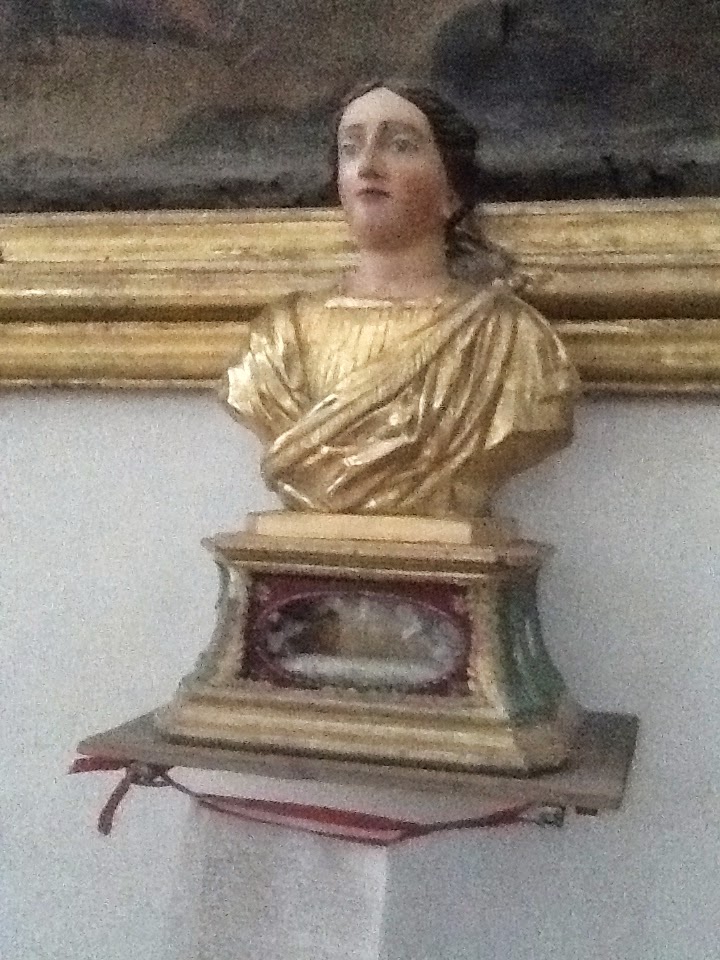
The relic of St. Perpetua, which would have been displayed behind the glass on her reliquary
 was stolen by some infidel or other.


For me this is a kind of ironical object d'art, however, I guess there is simply no broom cupboard
 in the church as the Blessed Virgin Mary is stored in a disused confessional box.


In the car park, a map of the area showing the various locations of
the different kinds of resistance activity.


Fountain in Place Francoise Beraud.
Francoise Beraud was a conseiller général
 de Barrème who died of exhaustion in Buchanwald in 1940.

Behind the fountain, across the tarmac, Louise waits in the sunshine for my return.
A man in a purple t-shirt is no doubt admiring her EFI.
(electronic fuel injectors)


Friday, 2 May 2014

Fountain 44 Madonna les Fountaines Le Brigue 21st August


Notre Dame des Fontaines

According to official records there had been a church on this site in 1375 as it was a
stopover point on the route from Italy to Santiago de Compostela, in Spain.

However, according to legend, this sanctuary was built after an earthquake
 had dried up the river which runs along its south side.
The inhabitants of the valley prayed for the return of the river to support their livelihood
and had built the sanctuary as part of their devotion. 
Once the building was completed, the water returned to the river bed.


 The water appears out of nowhere.

Up river is a barren bed of dry boulders.
Out of nothing in particular, bubbles up a generous flow of water which has
been constant for over six centuries.


The sanctuary has been known as the Little Sistine Chapel of the Alps.
The entire walls and ceiling have been painted by the Piedmontese artist, 
Giovanni Canavesio, depicting scenes from the Passion of Christ,
the Life of Mary and St. Thomas, and the Last Judgement.

Here we can see from left to right: Jesus riding his donkey into Jerusalem on Palm Sunday,
the Last Supper with his twelve Apostles, Mary Magdelene washing Jesus' feet,
Pontius Pilate unhappy about the trial of Jesus,
Jesus being whipped, and St. Peter denying his friendship with Jesus.

The frescoes were completed on the same day that America was discovered-
12th October 1492.

This date is particularly important to me for two reasons:
1) I was born in America, and after my birthday, this was probably the first date I memorised.
Like most little American children, I learned it by chanting the little jingle:
"In fourteen hundred and ninety two, Columbus sailed the ocean blue."

2) I use this date as a reference point, and think or sometimes say aloud, something like
" Wow, I can't believe this painting, building, philosophical treatise, tapestry, whatever,
was made before Columbus landed in American and they still believed that the world was flat
and if you sailed too far
 you'd drop off over the edge into a sea monster's mouth".

This date helps me to contextualise historical events, a bit like BC and AD.
(Before Columbus and After Discovery)


Canavesio employed the story telling device of 'continuous narrative' throughout his paintings.
The characters, who are easily identifiable by their clothing and facial features, pop up in 
several scenes throughout the chapel as the stories unfold.

Here we see Peter sitting inside a house warming his hands and feet over a fire while
he chats to the ladies. A man leans over and grabs Peter by his shoulder 
and accuses him of being a friend of Jesus.
To the right of the painting we see Peter leaving through an arched doorway, his hand is clinched by his eyes, (perhaps to hide his tears) and above his head on the wall a rooster is crowing.

"Immediately the rooster crowed the second time. Then Peter remembered the word Jesus had spoken to him: "Before the rooster crows twice you will disown me three times." 
And he broke down and wept."  (Mark 14:72)


The devil removes the soul from Judas Iscariot

Judas took betrayal a step further by revealing Jesus, with a kiss, 
to the temple guards in the Garden of Gethsemane.
But at least he felt the appropriate degree of remorse for his actions. 
Allegedly he flung his reward of thirty pieces of silver to the ground and hung
 himself from an elder tree (Sambucas Nigra, where grow fleshy edible fungus
 called Judas ears or Jew's ears (Auricularia auricula-judae),
(which incidentally taste very good when boiled in milk).

As a child I had always felt sorry for Judas,
 especially as I had been led to believe that he'd burn in an eternal hell for killing himself.
Whether he would burn in eternal hell for betraying Jesus wasn't mentioned,
 although the crime could have been expiated through confession.
 Had I been his judge I would have accepted his personal declaration
of regret and forgiven him whatever.


A little bit lifted from Wikipedia-
"Despite his notorious role in the Gospel narratives, Judas is still somewhat of an ambivalent figure in Christian history. Judas' betrayal, for instance, set in motion the events that lead to Jesus' Crucifixion and Resurrection, which, according to traditional Christian theology, brought salvation to humanity. Gnostic texts actually praise Judas for his role in triggering humanity's alleged salvation, and view Judas as the best of the apostles.[2] Furthermore, the Roman Catholic Church has never officially stated that it believes Judas is in Hell for his actions."

I wish I had heard about the Gnostic texts earlier in my life,
as I have been fretting over the unfair treatment of Judas ever since I was a little child.
Wikipedia is just the greatest.


Dice were possibly invented 5000 years ago in Iran and have been used
for 'casting lots' as an aid in decision making,
in games for children and most lucratively, in craps in Las Vegas.

After Jesus was nailed to the cross, the soldiers threw dice to see 
who would win Jesus' fine cloak. The cloak, or bits of the cloak,
now are in Trier, Argenteuil, or in Mtskheta, Georgia. (Where, I have just learned, it was brought back after the crucifixion by a priest with the same name as my son, Elias).

more Wikipedia lifting-
“Then the soldiers, when they had crucified Jesus, took His garments (ta himatia) and divided them into four parts, to every soldier a part, and the coat (kai ton chitona). Now the coat was without seam, woven whole from the top down. Therefore, they said among themselves, let us not tear it, but cast lots for it, whose it will become. Thus the saying in Scripture was fulfilled: they divided My raiment (ta imatia) among them, and upon My vesture (epi ton himatismon) did they cast lots” (John 19:23-24; quoting the Septuagint version of Psalm 21 [22]:18-19).