Sunday, 24 August 2014

Fountain 54 St. Yeuix Lesperch 28 August

                                             
St. Yrieix was a 6th century monk who founded the monastery
around which grew the town of St. Yeuix Lesperch. 

      He was a blood relation to Clovis, (c. 466 – c. 511)
"the first king of what would eventually become France".
After much persuasion from his wife, and a bit of political posturing, Clovis converted from paganism to Catholicism, thus setting into motion the French allegiance to the church of Rome.


  This is what I had believed to
  St. Yeuix's medieval golden reliquary head,
protected behind glass in the church and waiting for its day out on the town.

But now, after some research, I'm discovering it isn't the real thing, it is only a replica. ****
"Does that matter?" I often ask myself when confronted
 with the compromising aspects of modern life.

But I never have a good answer.


A photo from a display in the church
  
  The Ostensions is a traditional ceremony
 particular to the Limousin for the veneration of reliquaries.
The reliquary heads of local saints are carried in a procession
through the streets before being returned to the church.
Inside the head will be a relic, generally a piece of bone,
but it could be a bit of textile, that belonged to the saint in their life time.
The Ostensions are over a thousand years old
and since the 16th century they have been held every seven years.

Charming young girls dressed up as angels in white gowns and wings accompany
the head of St. Yreix as it is paraded about the town on his feast day, 25th August.
The followers invoke his protection for the town against "le mal des ardents",  the burning sickness.

**** after more research, I have discovered that the reliquary in St Yeuix Lesperch
is a 20th Century copy, but it does contain the actual skull of the saint.

  And this, no doubt, is the genuine medieval head of the saint.
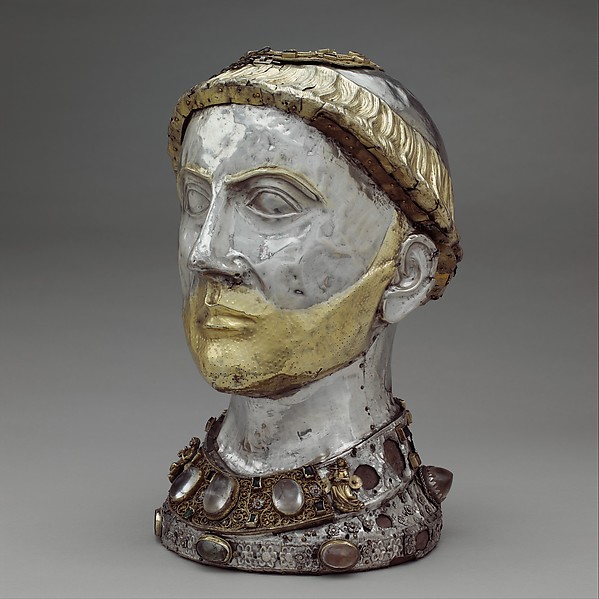


Reliquary Bust of Saint Yrieix, second quarter of 13th century
France, Limousin, Church of Saint–Yrieix–la–Perche
Gilded silver, rock crystal, gems, glass, originally over walnut core with silver leaf and gesso on interior; Reliquary: 15 x 9 3/16 x 10 1/4 in. (38.1 x 23.4 x 26.1 cm); wooden core: 14 7/16 x 8 7/8 x 9 13/16 in. (36.6 x 22.5 x 24.9 cm)
Gift of J. Pierpont Morgan, 1917 (17.190.352a,b)


Saint Yrieix, whose skull was once contained in this reliquary, was the sixth-century founder of a monastery south of Limoges that still bears his name. A special veneration of reliquaries in the form of the heads of local saints developed in the Limousin region during the Middle Ages and continues to the present. On feast days, the image would have been carried in procession through the streets and then placed on the altar for the veneration of the faithful. Although carefully carved, the wooden core was not intended to be seen but to provide support for the precious silver sheathing.


http://books.google.co.uk/books?id=8eD1Noek1yYC&pg=PA177&lpg=PA177&dq=Reliquary+Bust+of+Saint+Yrieix,+second+quarter+of+13th+century+France,+Limousin,+Church+of+Saint%E2%80%93Yrieix%E2%80%93la%E2%80%93Perche&source=bl&ots=TfPJq96KTi&sig=4_IQbFZXr1x6fBPdClUu8vKxG64&hl=en&sa=X&ei=PtNvVM32NYTIPMKvgagH&ved=0CDAQ6AEwAg#v=onepage&q=Reliquary%20Bust%20of%20Saint%20Yrieix%2C%20second%20quarter%20of%2013th%20century%20France%2C%20Limousin%2C%20Church%20of%20Saint%E2%80%93Yrieix%E2%80%93la%E2%80%93Perche&f=false

This is the longest link I have ever seen, not that I actually "look" at links,
however, this might also be one of the most interesting links I have ever seen.
Well worth a visit for those who like this sort of thing.


   A little procession of metre high plaster apostles lined up against the wall of a dim side chapel.


The feast day procession had come and gone three days earlier.
The church and town were virtually empty.
The fountain's flow was nearly exhausted.

The previous night I had stayed at a very neat and tidy campsite and spent the evening sitting on the wall outside the office, watching the spinning wheel go round on my ipad.
The promise of wifi delivering my emails and connecting me
 to the "real" world felt both important and a waste of my time.
 Facebook alerts that somebody likes candy crush or posted up a new profile photo
 made me ask the "Does this matter?" question again. 


Sunday, 17 August 2014

Fountain 53 Water tap, Souillac 27 August


St. James the Greater

son of Zebedee and Salome,
one of Jesus' 12 Apostles,
a fisherman, 
and the big brother of my favourite apostle, John the Beloved. 

James, recognisable by his walking staff, stout boots and the large scallop shell on his hat stands resolutely in the church at Souillac.
The scallop shell, the definitive symbol for the pilgrim, is now used to mark the routes to Compostela throughout Spain, France and Italy.
Originally it was worn as a sign of intention. It enabled the pilgrim to gain access to free bed and meals,but also acted as a talisman to ward of robbers

Now little metal scallop shell pins or pendants are sold at pilgrim route souvenir kiosks.
Even I have one to remind me of my visit to a personally important church.

There are several explanations for the appearance of the scallop shell.

According to Wikipedia, two versions of the most common myth about the origin of the symbol concern the death of  James.  According to Spanish legends, he had spent time preaching the gospel in Spain, but returned to Judaea after seeing a vision of the Virgin Mary on the bank of the Ebro River.  A while later, in 44 CE, James became the first martyr of the Christian church when he was beheaded in Jerusalem.
Version 1: After James's death, his disciples shipped his body to the Iberian Peninsula to be buried in what is now Santiago. Off the coast of Spain, a heavy storm hit the ship, and the body was lost to the ocean. After some time, however, it washed ashore undamaged, covered in scallops.
Version 2: After James's death his body was mysteriously transported by a crewless ship back to the Iberian Peninsula to be buried in what is now Santiago. As the ship approached land, a wedding was taking place on shore. The young groom was on horseback, and on seeing the ship approaching, his horse got spooked, and horse and rider plunged into the sea. Through miraculous intervention, the horse and rider emerged from the water alive, covered in seashells.
According to another, now forgotten, Catholic website :

Legends have sprung up that James evangelized Spain before he died but these stories have no basis in historical fact.
James is the patron saint of hat makers, rheumatoid sufferers, and laborers.  

Interestingly, being the patron saint of hat makers, rheumatoid sufferers, etc doesn't need to have a basis in historical fact, it just is a fact.


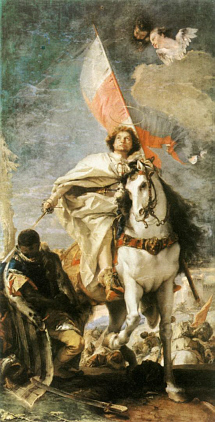
"St.James slaying the infidel Moors"

Oh internet! You treasure trove and den of iniquity.
My spelling is atrocious, as is my vocabulary. I no longer trust my definition for words and because I am interested in etymology, I Google and Google, even the most obvious and banal, which can open new doors and take me to interesting places.

While checking that I wasn't making a faux pas, I fell upon this shockingly xenophobic website.
Having been raised to be a devout Catholic I feel entitled to have an openly critical opinion, however, will I have my phone tapped?
Will I get through security at the airport if I cut and paste it here as an example 
 of what serves to fuel this senseless fire that is raging the planet and spoiling it
 for the rest of us open minded, peace loving individuals?

http://www.opusdeialert.com/st-thomas-aquinas-against-mohammed.htm

St. James the Moor Slayer

The Apostle of Jesus Christ, St. James the Moor-Slayer (Santiago Matamoros)
The [True] Catholic Church to this day, celebrates the miraculous appearance of St. James the Apostle, to the Catholic Armies of Spain in the 11th Century. St. James lead the Spanish Catholic Militia to triumphantly defeat the *infidel Mohammedans (Moors). All Catholics should invoke this Holy Apostle of Jesus Christ, asking his powerful intercession to once again, throw back the idolatrous Muslim hordes that are wreaking havoc on the vestige of what is left of Western Civilization.
*The word infidel is from the Latin infidelis and literally means "no faith." Chief examples are the unbelieving Jews and Mohammedans.
You what? Am I reading this correctly?
Can anyone actually believe this?
Not that I disagree with asking for saintly intercession,
but I was taught that Jesus said to 'turn the other cheek' and
that 'he who is without sin may cast the first stone' etc.
Perhaps I, too, join the infidels if I don't buy into the globalised religion of fear?

**Where is Archangel Michael when we need an unbiased judge of human deeds?
                                     or at least, where is the feeble human voice of reason?

                                               
 The Last Judgement by Hans Memling, painted 1445-50.
It hangs in the Hotel-Dieu, in Beaune, Burgandy, a hospital founded in 1452
 during a time of great destitution and plague.
 It depicts the Archangel Michael weighing the souls of the dead to determine their fate.

** With reference to the post Fountain 49 and its mention that Archangel Michael
 is one of the few figures who hold an important position in the three key
 (and warring) religions - Judaism, Islam and Christianity.


After a dry and inhospitable visit to Rocamadour earlier in the day,
I was grateful to find even a water tap in Souillac, where I could refill my bottle.


                                 Carved from a single stone, this knotted Celtic design of dogs
                                and beasts and griffons, with the sacrifice of Abraham tangled in,
                                             acts as a trumeau at Sainte Marie de Souillac.


         elsewhere in the church is a similar tangle of people in turmoil
 (as always, it seems)

Tuesday, 12 August 2014

Fountain 52 Muriac 26 August

"à droite, tourner à gauche, tout droit, tourner à gauche, continuer sur la droite"

I did all theses things, more than once, and somehow always ended up where I started : not far from the tabac and the huge  map of the town and surrounding area. If there was a sun I would be able to orientate myself. But grey and cold and wet are confusing states for me.
The little tent icon and the lake were firmly on the map, yet so elusive.

Val St. Jean, A Holiday Camp.
Generally not my cup of tea.
Generally priced out of my humble budget to reflect the amenities- pools with happily screaming children charging down spiraling super slides, gangly legged adolescents leaning heavily on their club for a round of goofy golf with the over keen parents, gyrating discos, off key karaoke, and themed soirees where sometimes, close to midnight, the noise levels rise and it sounds like everyone has abandoned their chairs and are dancing on the tables.

I am a quiet camper.
I don't even like unzipping my tent when all has gone sleepy and peaceful.
( although I do enjoy a little existential laugh to myself/ at myself while listening to the ziiiiiiiip zzzzzziiiiiiipppp, zip as we all shut ourselves into our permeable cocoons)

I wouldn't really define myself as parsimonious, but apart from preferring a simple field with only a flush toilet and a hot shower, I can't afford to camp for seven weeks in the luxury sites. I love the flee market thrill of a genuine bargain and simple municipal camping costing four euro has that bargain edge to it.

The reception at Val St. Jean reminded me of an American resort. There were lots of  sparkling windows, soft chairs and racks of tourist attraction leaflets.

I left little muddy puddles as I crossed from the door to the desk.

With a sigh, and the  barely perceptible nodding movement of the head that I now remember my father doing in awkward financial transactions, I gave the man 30 damp euro.
Without making eye contact, he returned most of  it and even pulled a few warm coins out of the drawer.

Steamy showers.
Toilets with loo paper.
Free wifi in a heated television room.
I dry my boots and gloves on the radiator.
I smile at the children who alternate their stares between a sci fi horror with ooze dibbling monsters and me.

Merci St. Jean, I've landed with my nose in the butter.


 Fountain  in  Muriac


 Childebert, daughter of Clovis I, allegedly had a vision of the Virgin Mary, 
accompanied by St. Peter, carrying the baby Jesus. 
This led her to found a chapel at the side of the Rieu Mauri,
 the small stream now known as the ruisseau Saint-Jean. 
The little chapel attracted pilgrims and grew over the centuries to become the basilica
Notre-Dame-des-Miracles. 


                                     a  little beetle-bellied Jesus with a super sized halo


possibly the patron who erected the cross,
barefooted, wearing a full pleated gown
 and a headdress which looked like a crown (or Cossacks hat)

Wednesday, 30 July 2014

Fountain 51 Rioms e Montagnes 26 August


                                         " Fountain 51.  Cantal. wishes for Ali. cold and wet."
were the only comments I made in my very weathered fountain notebook.

 And now, nearly a year later, how clear the olfactory memories are:
  fresh rain on dusty tarmac and low clouds tinged with the warm honey scent of gorse flowers.

Nevertheless, the rain had already sodden my gloves and boots hours ago.
My wet hands and feet were freezing and the intrepid explorer in me
wanted only a dry tent, a hot shower and a nice cup of tea.
 If there was a campsite nearby it was hidden in the mists of this high and remote area.

 The fuel warning light had been illuminated for quite a while, like an elbow poke, warning me something like, "no pressure but you might get stranded here, soaked to the skin with an equally wet tent in the middle of nowhere with one shriveled carrot and a half a bag of peanuts." 

Despite the thousands of miles I've driven in France, I've never been able to fully understand the French relationship to petrol stations.
Italy seems to have an unannounced petrol station every few hundred yards.
In France, I've grown to doubt the road signs for the various supermarkets with their promise of 24/7 petrol. Too many times I have driven miles off course chasing an illusive E.Leclerc or Carrefour to discover that the petrol station was shut for lunch or because it is after 7pm and my credit card is rejected by the self-service machine.


       Rioms' fountain was built up against the church wall which is a bit unusual.
        (I am trying to be more careful with my "never seen this before"exclamations which only prove how unobservant I really am.)


                         Oops sorry sorry sorry... this cute little wonky Jesus was actually in Rioms
                                       not   "Fountain 50   Roffiac    25 August"

Wednesday, 16 July 2014

Fountain 50 Roffiac 25 August

                                                        
                                                              The tower at Rouffiac

The weather had changed quite suddenly after a sunny morning in Le-Puy.
A white grey sky threatened a passive sort of rain as I went deeper into the misty wilds of the Cantal.

The tower at Roffiac is only a half round and it sits unassumingly at the side of the road. Had it been a full round tower, I probably wouldn't have stopped. What appeared to be "missing" was more interesting than what was present.

I wish now that I had read the signs.
Or maybe I had and have forgotten what they said.

So often in life we either misread or forget the signs and then wonder why we end up in
 awkward and uncomfortable predicaments.

Even my 24-7 guru, Wikipedia, had little to offer apart from the absolute basics.
So now I know Roffiac has 27 people per square km.
 My mostly rural county, Devon, has 169 people per square km which is slightly more than Andorra's 167 and enormously less than Macao SAR China which has 19,885 people per square km.

Fortunately, or not, depending on how you look at it, Macao has only 31.3 km.


                  Crucified Jesus with many ribs


                                          Very cute Jesus with a curiously wonky hand and leg.

The cross also includes a serpent, a sheep, two small heads and something which reminds me of Sheelanagig, the sculpture,
(http://www.britishmuseum.org/explore/highlights/highlight_objects/pe_mla/s/sheela-na-gig.aspx)
not Sheelanagig, the band from Bristol, who are also very good.


                     Fountain at Roffiac


Sunday, 13 July 2014

Fountain 21 The Tree of Life or p.s. something I have found right under my nose, so to speak.


Silly me.
Having said on my Fountain 21 post:


  "Dore-L'Eglise
 c. 15th-16th Century stone cross depicting baby Jesus swaddled 
and patient in anticipation
 of his ultimate crucifixion thirty-three years later.


I have never seen this iconography on any of the hundreds of French stone crosses that I come across in my travels.....etc etc..."


                   I then found this small (10x15 cm), low relief image of the swaddled baby Jesus.


It was hanging on the wall in my bedroom where it has hung for 15 years and suddenly, in my more domestic travels with a dusting cloth, I see it afresh.

The inscription INRI, Iesvs Nazarenvs Rex Ivdaeorvm  (Latin for "Jesus of Nazareth the King of the Jews") that was mounted above Jesus' head at the time of his crucifixion by the ironic Pontius Pilate, is replaced by a little plaque inscribed with "Arbor Vitae" at his feet.


I am always fascinated by the process of communication and the power of the symbolic inferences in the words we so easily use willy-nilly.

The Tree of Life can mean many things, sacred and profane, to many people:
                        
  • Tree of life (biology), a metaphor describing the interrelatedness of living things through evolution
  • Tree of Life Web Project, a collaborative project providing information about the diversity and phylogeny of life on Earth
  • Arborvitae (Latin for "tree of life"), Thuja, a genus of coniferous trees
  • Arbor vitae (anatomy) (Latin for "tree of life"), the cerebellar white matter, named for its branched, tree-like appearance
  • Baobabs (sometimes called the "tree of life"), a genus of African tree
  •  arbor vitæ uteri, a part of the canal of the cervix
     
==Sculpture==*Wrap Sculptures series, Edenic collapsed-volume wrap sculpture "Trees Of Life" installations developed by Peter G Pereira, New York City


Wikipedia, again I bow down to you as a starting point and an ending point and all the points in between for the information/misinformation you so generously give.


Friday, 11 July 2014

Fountain 49 at the base of St Michel d' Aiguilhe Le Puy-en-Valey


I have already written about this visit in Le-Puy-en-Valey August 25, 2013
however, I am in my own personal and generally mistaken way, thorough and methodical,
and Fountain 49 comes after Fountain 48.


                                          The fountain at the base of St. Michael d' Aiguile


    Detail of the fountain with the Archangel Michael stamping down Satan, a fallen angel.

Interestingly, in these days of accusation, disharmony and divide between Christians (a term used very loosely because although being Christian is not fashionable, celebrating Christmas and Easter is ubiquitous) Jews and Muslims is an important commonality. 
All three religions believe that Archangel Michael is a leading angel 
who fights evil with the power of good.

He is the only angel mentioned by name in all three of the major sacred texts of the world's religions: the Torah (Judaism), the Bible (Christianity), and the Qur'an (Islam). 

If everyone is "believing" the same thing 
why are there so many problems with world peace and all that stuff?

Ok, hands up those who don't believe.


Fallen man is not allowed.


                                       Trefoil arch above the entrance to St. Michael's Church


The reliefs within this curious arch depict the Lamb of God (labeled with AGNUS DEI) 
in the center and four Elders of the Apocalypse hold vials on either side. 
Above the arch are elaborate vines populated with birds and two human figures
 with "Green Men" under their feet.
Below the arch are vines which issue from the mouths of large human heads 
and contain birds pecking at grapes.

The lintel is carved with two mermaids: one with a snake's tail and one with the tail of a fish.
I frequently come across these charming creatures in France and Italy.
And if my eyes were more open, I might find them more often in England.


Something I hadn't mentioned in my first writing about the history of St. Michael's Chapel:

There are three great stones, considered to be the remains of a prehistoric dolmen built 
at the top of the rock, that have been incorporated into St. Michael's Chapel.

Then later the Romans worshiped Mercury, the swift messenger god
 with his winged shoes at the site. 

When the area was eventually converted to Christianity the rock was consecrated
 to St. Michael the Archangel, the patron of high places.